The screenshots in this article were hosted on Blogger and are no longer available. The text and the code are complete.
HOW THE ECONOMY WORKS
As workers, we work to receive a payroll in return; that is, we get money from a workflow obtained by the company. Depending on its needs, the company can obtain credit from the financial market, just like workers/consumers; in this way, there is a money flow in the form of credit between the market and companies or workers/consumers. Finally, we have the goods and services market, which receives products from companies while paying the company for those products, and the goods and services market is responsible for selling them to consumers in exchange for money.
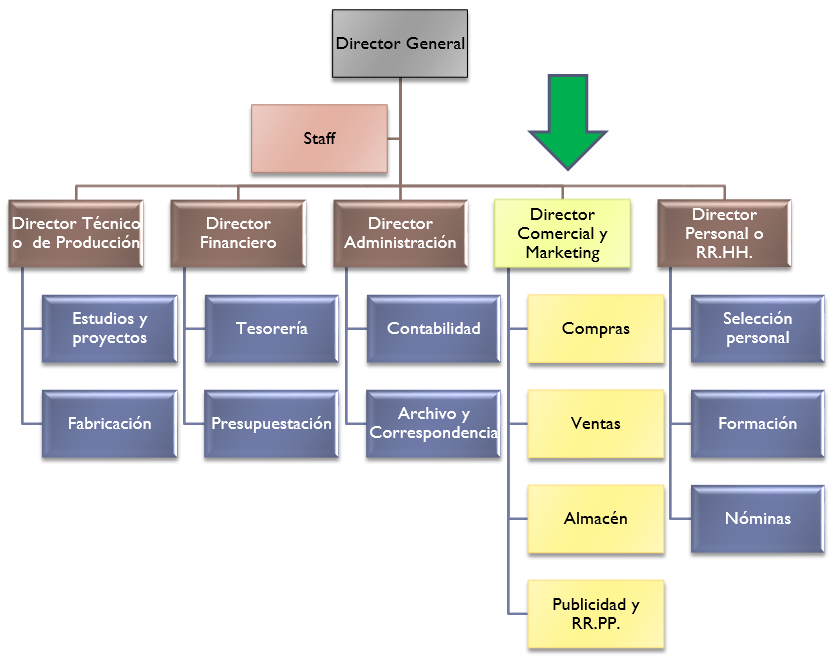
COMPANY ORGANIZATION CHART

In a company, it is clear that there is a general manager, and below them we find the staff, where we can find:
- Technical or Production Director, in charge of studies, projects, and manufacturing.
- Financial Director, in charge of treasury and budgeting.
- Administrative Director, in charge of accounting, archive, and correspondence.
- Commercial and Marketing Director, in charge of purchasing, sales, warehouse, advertising, and PR (Public Relations).
- HR Director or Personnel Director, in charge of recruitment, training, and payroll.
CRM Modules
- Virtual store.
- Navigation.
- Shopping cart.
- Purchase-associated services:
- Registration.
- Personalization.
- Community.
- Others.
Payment. Security.
Catalog management.
- Bulk data processing.
- Selective data processing.
- Product verification.
- Catalog tools.
Content publishing.
- Content editing.
- Content publishing.
- Content management.
Customer service.
- C.R.M.
- Call center: On and Off-line.
- Reverse marketing.
- After-sales service.
Shipping logistics.
- Stock check.
- Invoicing.
- Picking.
- Handling.
- Packing.
- Shipping.
Reverse logistics.
- Returns
- Collection and replacement.
- Customer order verification.
- Delivered order verification.
- Relationship with transportation.
- Relationship with purchasing department.
- Relationship with C.R.M.
Warehousing.
- Goods receipt.
- Order verification.
- Product verification.
- Location.
- Stock control.
- Inventory.
Procurement.
- Product strategy.
- Vendor management.
- News/updates service.
- Order management.
- Returns management.
- Product coding.
- Pricing policy.
Marketing.
- Promotion.
- Self-promotion.
- Loyalty.
- Revenue Sharing.
Business.
- Strategy.
- Business intelligence.
- Positioning.
Accounting.
- Invoicing.
- Balance sheet.
- Closing...
Legal advice.
- LOPD) (Organic Law on Protection of Personal Data).
- APD (Data Protection Agency).
[](http://www.limit4.com/spa/item/resource/mrkcrmoracle.JPG)
CRM is a set of applications that will allow you to centrally manage both customer information and company-customer interactions.
The CRM model centrally provides a complete and detailed view of the customer, which guarantees optimal business decision-making.
CRM integrates the latest technologies, providing the company with the means to evolve from traditional service, marketing, and sales models to models based on the Internet and mobile devices, expanding market reach thanks to the ability to access it anytime and anywhere.
Management modules:
| Management module | Features* | Benefits |
|---|---|---|
| Marketing | Suite of applications with management, execution, analytical, and campaign tracking tools. | Ensures return on investment in Marketing. Increases Marketing reach. Effectively impacts the customer. |
| Sales | Suite of applications coordinating all sales across all channels. | Increases effectiveness. Aligns commercial activities with goals. Delivers real-time customer/sales information to the Sales team. |
| Services | Integrated and global service delivery, as well as cost-effective customer care. | Increased revenue. Higher customer satisfaction. Greater agent efficiency. |
| "Call-Center" Interaction | Provides the necessary technology to integrate your databases with the telephony system. | Transforms your traditional call center into a powerful profit generator, multichannel E-Business, Sales, Marketing, and Service. |
| E-Commerce | Oracle e-Commerce offers integrated applications focused on shaping business processes. | Supports the entire business cycle online. Homogeneity on the internet. Personalized relationships. Greater customer loyalty. |
What is a CRM?
CRM (Customer Relationship Management) is one of those terms within the so-called "new economy."
Traditional methods for gaining customer loyalty are based on things like reward points, cumulative discounts, loyalty cards, etc. However, the problem with these types of methods is saturation, both of the market and of consumers themselves, who feel the relationship is purely transactional.
Therefore, what truly builds customer loyalty is perceiving special value in the company.
Customers no longer aspire to be treated equally, but individually.
Thanks to technological advances, CRM has the necessary technology for mass data handling, or data mining, and the e-commerce phenomenon.
A comprehensive definition of CRM would be something like "a marketing strategy aimed at proactively building a preference or bias in consumers for a specific organization, which usually results in higher retention rates for those consumers and greater economic performance."
CRM is based on a radical shift in the company's strategic orientation; it must involve all company employees, from call operators to technical service managers. All company personnel must be a potential source of incoming information from the customer.
Methodology:
- Identify customers. It is essential that we can always know who they are, regardless of which channel they use to enter, so that they are always seen as the same customer throughout all transactions and interactions over time. We must be able to store all customer information without losing anything if we want to enable what comes next.
- Differentiate them. Be able to assign those previously identified consumers to defined groups characterized by common patterns, by the type of needs they pose to the company, or by the value they hold for us. Whether I approach the company through its website or a technical service technician comes to my house, even if sub-contracted, I, as a customer, must see that I am recognized—and if I am or consider myself a very good customer, that it is known and that I am treated as such.
- Interact with them. This involves maintaining contact with those consumers based on the information we have about them and their needs, and recording those contacts as additional sources of information. These contacts will be made depending on the benefit they bring to the company. Thus, mass mailings with the same offer will end, and offers will be tailored to the customer.
- Adapt our product or service to those customers. To cover their needs more efficiently, adaptation or customization is the hardest step in any CRM strategy and requires deep integration and proper functioning of the previous three stages. It is about making sure that our product or service actually fits what the customer was asking for, within reasonable limits.
You start by visualizing the topic broadly, with all its implications. Consider the starting point (starting from scratch in a company that traditionally treated its customers poorly is not the same as starting from a business where the customer was always considered king) and the potential for staff to adapt to this philosophy. Then, we must acquire the right tools to manage the massive amount of information we will generate, and ensure that implementation is not traumatic—because a perfect system that lets sales representatives see customer data on screen while talking on the phone is useless if that rep doesn't bother to log that new contact in the system.
20% of customers will generate 80% of revenue, so to start, it is worthwhile to retain these customers.
Therefore, CRM as defined consists of 10 components:
- Sales functionality and management.
- Telemarketing.
- Time management.
- Customer service and support.
- Marketing.
- Executive information management.
- ERP (Enterprise Resource Planning) integration.
- Excellent data synchronization.
- E-commerce.
- Field service sales.
It is nothing new, but it has incorporated new technologies, which have enabled its enhancement.
Competition does not allow neglecting the protagonist: the customer.
However, the benefits of CRM are not only focused on customer retention and loyalty, but also on having more effective marketing, creating smart cross-selling opportunities, and enabling the rapid introduction of new products or brands.
Ultimately, what companies want is to reduce the cost of acquiring new customers and increase the loyalty of those who have already engaged. The latter become one of the company's most valuable assets.
CRM success factors:
- Determine the functions to be automated.
- Automate only what needs to be automated.
- Secure support and commitment from top company leadership.
- Use technology intelligently.
- Involve users in building the system.
- Prototype the system.
- Train users.
- Motivate the staff who will use it.
- Manage the system internally.
- Maintain a system administrative committee for questions or suggestions.
Thanks to CRM, the company should be able to anticipate customer desires. The true meaning of CRM for a company is: increase sales, increase profits, increase margins, increase customer satisfaction, and reduce sales and marketing costs.
Reasons why CRM can fail:
- Thinking that technology is the solution.
- Lack of management support due to a lack of understanding of the opportunities CRM offers.
- Absence of "passion for the customer" in the organizational culture.
- Unclear return on investment because it is not a mature sector and there is general ignorance regarding its role.
- Lack of vision and strategy.
- Failing to redefine processes.
- Poor quality of data and information.
- Integration issues.
- Failing to properly manage change.
- Low implementation of analytical CRM.
Causes can also be due to market "immaturity", such as poorly evolved and valid solutions, lack of solutions, lack of specialized consultants...
Examples can be consulted here.