What it carries
Passwords and keys written into the firmware, open services, libraries with known flaws and default settings.
Every connected device you sell is a door into your network and your customers'. Before you build a hundred, I check what it carries and how it communicates, and tell you what to fix first.

What I work with
Passwords and keys written into the firmware, open services, libraries with known flaws and default settings.
Whether what it sends is encrypted and whether the device and the server really recognise each other.
That nobody can use the update channel to slip another program onto it.
I review the Linux server or gateway that receives the information.
Each issue with its risk, how to check it and how to fix it, ordered by urgency.
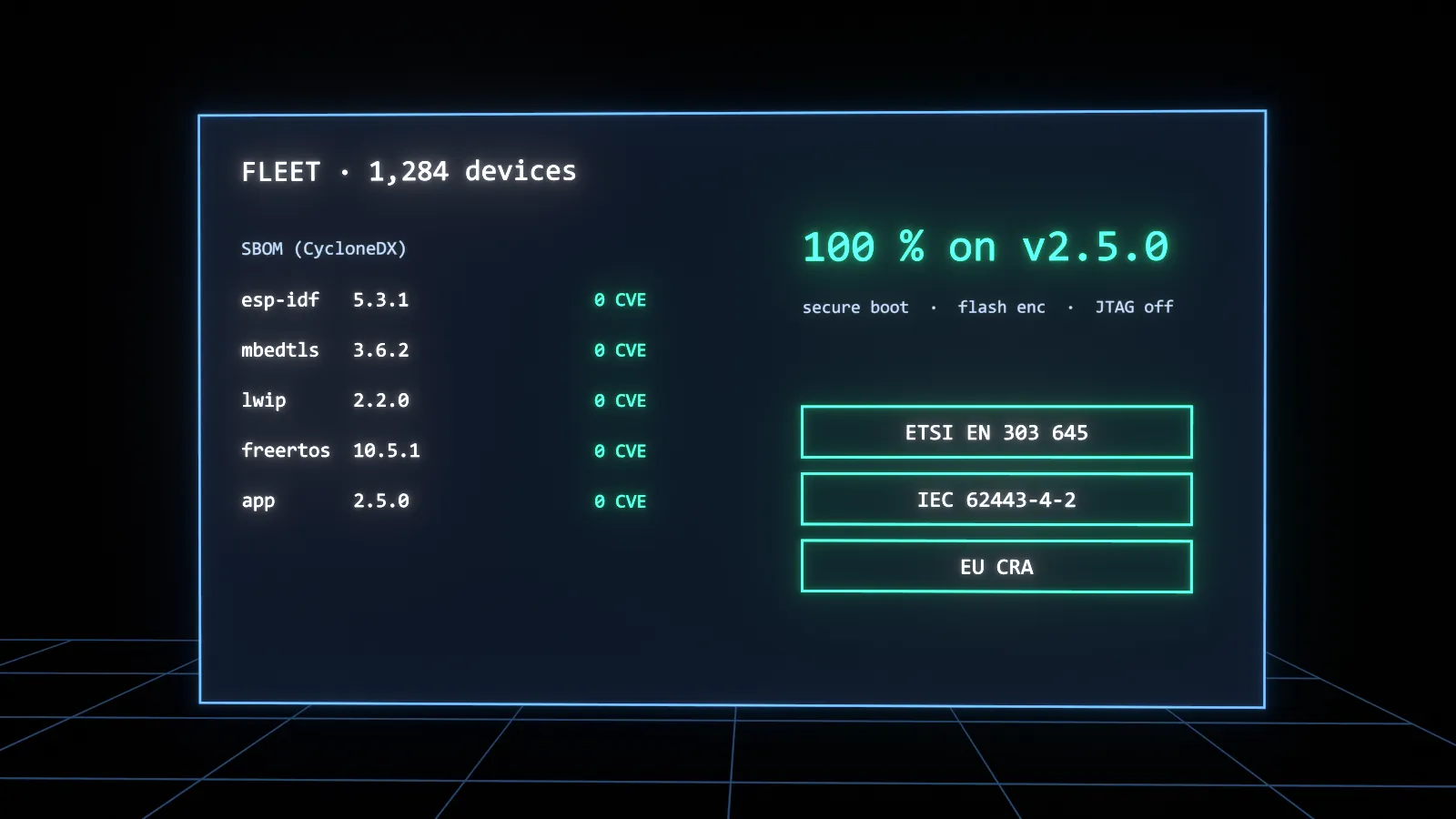
Encrypting the connection isn't enough. A robust device verifies its own firmware at boot, protects what it stores, only talks to peers holding a certificate and refuses unsigned updates and old versions. And you can prove it.
Four steps and no surprises: at every point you know what comes next, what you get and what it costs.

You tell me what you need, what you already have and what worries you. No commitment, no jargon.
You get: An honest view on whether it is feasible and where I would start.

In writing: what I will do, what you get, in what order and what it costs. Before starting.
You get: A fixed proposal with scope, phases and price.

You see and test partial deliveries. No black boxes opened at the end.
You get: Prototypes and versions you can hold and test.

Files, documentation and support during commissioning. And I am still around afterwards.
You get: Source files, documentation and someone to call.
Before mass production or installation. Fixing it in the design costs far less than fixing it in the field.
Yes. The Cyber Resilience Act sets security requirements for connected products, and a prior review tells you where you stand.
If you want, yes. And if you would rather your team did it, the report has enough detail for that.
Tell me where you are and what worries you. You will hear back from me, not from an automated form, with how I would approach it and, if it fits, a fixed quote.
I can also help with