Schematic
I pick every part with power, price and whether you will still be able to buy it in two years in mind.
You have a prototype that works on the bench, or just an idea, and you need to turn it into a printed circuit board that can be built, assembled and repaired without surprises. That is what I do.

What I work with
I pick every part with power, price and whether you will still be able to buy it in two years in mind.
I place and route the board so it can be machine-assembled and tested at the factory without headaches.
I compare price, stock and alternatives across distributors before committing to production.
I prepare the files, talk to the manufacturer and validate the first units with you.
Already have a board? I take a second look and give you the issues ordered by importance.

Every design decision shows up when the board reaches the factory. So I plan it from the start to be machine-assembled, quick to test and easy to source.
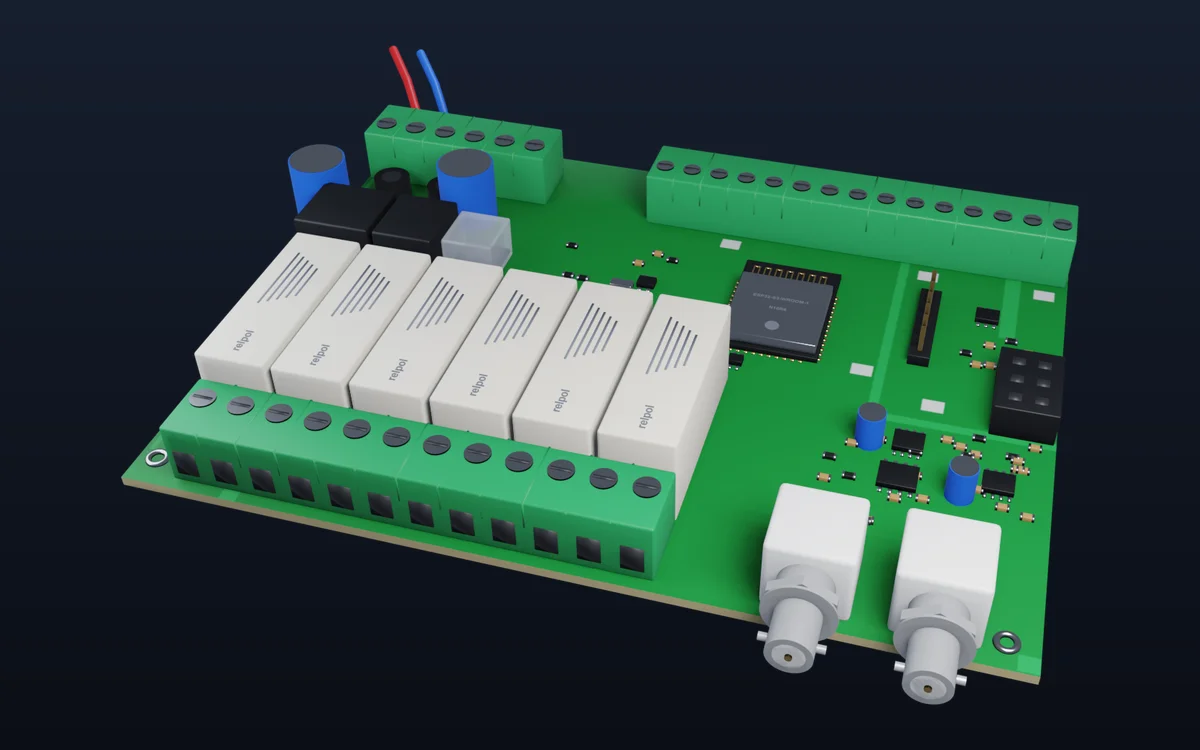
The board you see is the Olimex ESP32-EVB, open hardware (Apache 2.0 licence), built in 3D from its KiCad files. GitHub →
Four steps and no surprises: at every point you know what comes next, what you get and what it costs.

A first review of your project, about 30 minutes and free: you tell me what you need, what you already have and what worries you. No commitment, no jargon.
You get: An honest view on whether it is feasible and where I would start.

In writing and in stages: what I will do, what you get in each one and what it costs. Depending on the project, it is agreed as a whole or stage by stage, always before that stage starts.
You get: A proposal with scope, stages and the price of each.

You see and test partial deliveries. No black boxes opened at the end.
You get: Prototypes and versions you can hold and test.

Files, documentation and support during commissioning. And I am still around afterwards.
You get: Source files, documentation and someone to call.
Knowing what the device must do and where it will work. If there is a prototype, even on a breadboard, we start there.
Yes, and it is one of the most useful things to order: a schematic and layout review with a prioritised list of changes.
Yes. Designing the board and the firmware together saves a lot of back and forth. See the firmware service.
Tell me where you are and what worries you. You will hear back from me, not from an automated form, with how I would approach it and, if it fits, a proposal in stages with a fixed price for each.
I can also help with

