What is exposed
Ports, services and panels visible from the internet, versions with known flaws and default settings.
I review what you have exposed, tell you what to close first and why, and leave it hardened: access, services, backups that can be restored and alerts when something does not add up.

What I work with
Ports, services and panels visible from the internet, versions with known flaws and default settings.
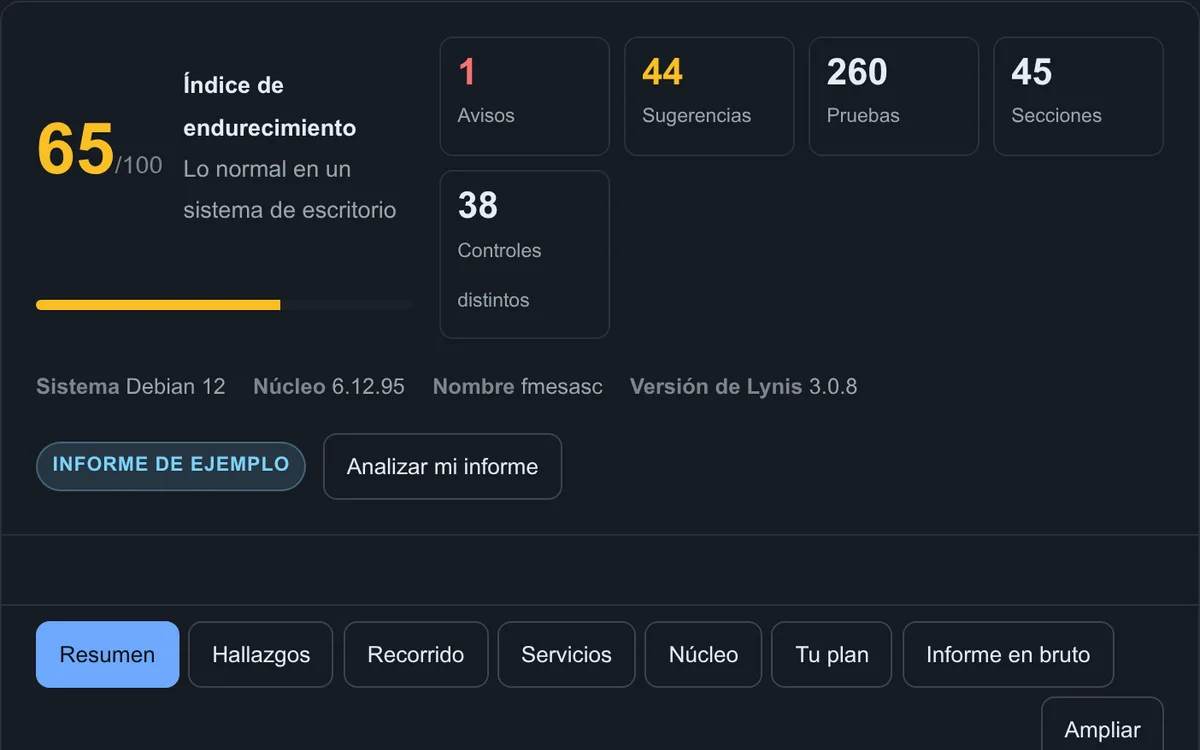
Audits with Lynis and the CIS benchmarks, and each finding with its real risk: what is worth fixing and what is not.
Who gets in and how: keys, passwords, lockout after failed attempts, second factor and least privilege.
Encrypted, off the machine and tested: a backup that has never been restored is not a backup.
Logs that get read and alerts on your phone when something is off, without turning it into noise.
Four steps and no surprises: at every point you know what comes next, what you get and what it costs.

A first review of your project, about 30 minutes and free: you tell me what you need, what you already have and what worries you. No commitment, no jargon.
You get: An honest view on whether it is feasible and where I would start.

In writing and in stages: what I will do, what you get in each one and what it costs. Depending on the project, it is agreed as a whole or stage by stage, always before that stage starts.
You get: A proposal with scope, stages and the price of each.

You see and test partial deliveries. No black boxes opened at the end.
You get: Prototypes and versions you can hold and test.

Files, documentation and support during commissioning. And I am still around afterwards.
You get: Source files, documentation and someone to call.
Linux servers, Docker containers, the office network and work computers. If it is something else, let’s talk.
Whatever you prefer: a prioritised report for your team, or I fix it in stages, starting with the most urgent.
The review stops nothing. Changes are planned so nobody is cut off, and anything delicate is tested first.
Tell me where you are and what worries you. You will hear back from me, not from an automated form, with how I would approach it and, if it fits, a proposal in stages with a fixed price for each.
I can also help with